
Tax-Deductible Expenses for Doctors in the UK: What You Can Claim and How
 By
Most doctors pay more tax than they need to. The reason is simple. They miss costs they can claim. This guide covers Tax-Deductible Expenses for Doctors in the UK, from GMC fees to home working costs.
You will see what HMRC accepts, what it refuses, and how to keep proof. Rules differ for consultants, GPs, and locums. Knowing Tax-Deductible Expenses for Doctors by job type can save you real money.
Table of contents
- What expenses can doctors claim on tax? The short answer
- Employed NHS doctor or self-employed locum: why the rules differ
- Allowable expenses for doctors: comparison by employment type
- Self-employed doctor expenses: locums, private practice and GP partners
- Common doctor tax relief claims HMRC rejects
- How to claim tax relief as a doctor: P87, online or Self Assessment
- Worked example: how much a registrar could get back
- Doctor tax relief checklist by career stage
- Frequently asked questions
- Conclusion
Quick Answer: What Expenses Can Doctors Claim Against Tax?
What Expenses Can Doctors Claim Against Tax? You can claim costs you pay wholly and only for work. Common claims include GMC fees, professional body fees, indemnity cover, medical equipment, work travel, and course costs. Your job status decides how you claim. Employees claim through tax relief. Self-employed doctors deduct costs from their profits.
How HMRC Allowable Expenses Work
HMRC allowable expenses follow one main test. The cost must be “wholly and exclusively” for your work. A cost with a private purpose usually fails.
Two groups of doctors claim in different ways:
- Employed doctors (NHS consultants, registrars, salaried GPs) claim limited relief on costs the job requires.
- Self-employed doctors (locums, partner GPs, private consultants) deduct a wider range of costs from income.
Here is a simple example. A locum buys a stethoscope for £150 and uses it only at work. That cost is claimable. A coat bought for the same shifts is not, because you can wear it anywhere.
- Employed (PAYE): NHS hospital doctors, resident doctors and salaried GPs.
- Self-employed: locums working on their own account and doctors in private practice.
- GP partners: self-employed, with costs claimed through the partnership.
Many doctors have both PAYE and locum or private income. Each income stream follows its own rules and claim route, so keep their costs separate.
Allowable Expenses for Doctors UK: Core Claims
Allowable Expenses for Doctors UK fall into a few clear groups. Check each one against your own job.
Professional Fees and Registration
GMC registration fees and professional subscriptions are the most common claim. HMRC keeps a list of approved bodies. Many medical bodies sit on it.
You can usually claim:
- Your annual GMC retention fee
- Royal College subscriptions
- BMA membership
- Specialist society fees, if HMRC approves the body
Your payslip may show fees paid directly. Check you do not claim twice.
Indemnity and Insurance
Private practice indemnity is claimable for self-employed doctors. Many NHS doctors have cover through state schemes, so they pay little. Pay attention to what you actually fund yourself. Only that part counts.
Training and Exams
Courses that keep your current skills up to date are claimable. Study for a new qualification is not. A CPD course in your field passes the test. A degree that opens a new career does not.
Tax-Deductible Professional Fees and Medical Equipment
Tax-Deductible Professional Fees and Medical Equipment need a closer look, because the rules split by status.
Equipment for Self-Employed Doctors
Self-employed doctors can claim capital allowances on kit used for work. This includes:
- Diagnostic tools
- Laptops and tablets used for patient work
- Medical bags and instruments
- Consulting room furniture
The Annual Investment Allowance often lets you deduct the full cost in the year you buy. Check the current limit on GOV.UK.
Equipment for Employed Doctors
Employees face a tougher test. If your trust supplies the kit, you cannot claim your own. You may claim only when the job demands you buy it and no free option exists.
Allowable Business Expenses for GPs and Consultants
Allowable Business Expenses for GPs and Consultants vary by how you run your work.
Partner GPs and Locums
Partner GPs and locums can often claim:
- Accountancy fees
- Locum agency fees
- Software and phone costs
- Business insurance
- Bank charges on a work account
- Use of home as an office, on a fair share basis
Private Consultants
A consultant with private work can claim rooms, secretary costs, billing software, and marketing. Keep NHS and private income separate in your records. This makes your claim cleaner.
Salaried Consultants
If you only hold an NHS contract, your list is shorter. Fees, some travel, and a few home costs are the main items.
Travel and Mileage
Travel is a common source of errors.
- Trips from home to your permanent workplace are not claimable.
- Trips between work sites are claimable.
- Trips to a temporary workplace can qualify.
HMRC sets approved mileage rates for business trips in your own car. Check the current rates before you file. Keep a log with date, start point, end point, and miles.
Locums often have a different position. Each placement may count as a temporary workplace. Get advice on your own pattern before you claim.
Professional indemnity insurance and medical defence organisation fees
Professional indemnity insurance you pay yourself is claimable as an employee only if your job needs it. NHS indemnity schemes already cover most NHS work, so many hospital doctors claim only the part of an MDO (medical defence organisation) fee that covers their employment. For locum and private work, indemnity is a standard business cost.
Travel and mileage: rotations, temporary workplaces and commuting
Travel to a permanent workplace is commuting and never qualifies. Travel to a temporary workplace does: generally one where you expect to work for less than 24 months. How HMRC treats each training rotation depends on your contract and placement letters.
- Claimable: trips between sites during the working day, and trips to a temporary placement.
- Not claimable: home to your permanent base, and private trips.
Employees claim mileage allowance relief at the HMRC approved mileage rates (45p a mile for the first 10,000 miles, 25p after), minus what the employer pays. Self-employed doctors can use the same flat rates or claim actual car costs for the business share.
Uniforms, scrubs and clothing
Ordinary clothing never qualifies, even if you wear it only at work. If your employer requires a uniform but does not wash it, you can claim a flat-rate amount for laundering it. Scrubs the hospital launders are not claimable.
Exams, training courses and CPD
Royal college membership is often allowable, but exam fees and courses that lead to a new qualification generally are not. Self-employed doctors can deduct CPD (continuing professional development) that keeps existing skills up to date.
Equipment, books and phones: employees versus capital allowances
Employees can claim only for items they must buy to do the job, that the employer does not provide and that have no private use. Self-employed doctors can claim capital allowances, usually the Annual Investment Allowance, on equipment. Employees can claim business calls but rarely home office costs.
Self-employed doctor expenses: locums, private practice and GP partners
Self-employed doctor expenses are deducted from locum or private income on your Self Assessment return. Each cost must pass the “wholly and exclusively” test explained earlier. Typical deductions include:
- indemnity and MDO fees
- accountancy fees
- business travel and mileage
- the business share of phone and home running costs
- locum agency or chambers fees
HMRC’s helpsheet HMRC HS231 Doctors’ Expenses sets out what doctors can claim. GP partners claim through the partnership’s accounts, and each partner’s share of profit then goes on their own return.
Common doctor tax relief claims HMRC rejects
Most rejected doctor tax relief claims fail because they break one of the tests set out above.
- Commuting to a permanent base: HMRC sees this as private travel (see the travel subsection).
- Everyday clothing: it has a private use, even if worn only at work.
- Exam fees for a new qualification: they buy a new skill rather than keep up an existing one.
- Costs your employer repaid: you have not borne the cost yourself.
- Bodies not on List 3: only approved bodies qualify.
- Claiming the full cost back: relief is given at your tax rate only.
How to claim tax relief as a doctor: P87, online or Self Assessment
Employees with expenses below £2,500 can claim online or by post on form P87. Anyone above that, the self-employed and anyone already filing must use Self Assessment.
- Work out your allowable costs using the rules above.
- Employed only and under £2,500? Use the online claim on gov.uk or form P87.
- Over £2,500, or with locum or private income? Claim through Self Assessment.
- HMRC usually adjusts your tax code for the current year and refunds earlier years.
Backdating claims: how many years can you go back?
You can claim for the last four tax years. For example, claims for 2021 to 2022 (6 April 2021 to 5 April 2022) must reach HMRC by 5 April 2026.
Tax rebate companies: fees and risks
You can claim from HMRC directly for free. Rebate firms usually keep a share of your refund, and some ask you to sign the refund over to them. You stay responsible if a claim made for you is wrong.
Records and receipts to keep
- receipts and subscription confirmations
- a mileage log: date, from, to, purpose, miles
- rota or placement letters showing temporary workplaces
Keep records for at least 22 months after the tax year as an employee, and about five years after the filing deadline if self-employed. Copy this log:
| Date | From | To | Purpose | Miles | Cost (£) |
|---|---|---|---|---|---|
Worked example: how much a registrar could get back
An illustrative ST3 registrar on PAYE in England, paying higher-rate tax, could get back £705.60 on £1,764 of allowable costs. All figures are example figures.
Step 1: check each cost. A £700 membership exam fee is excluded (new qualification). Home-to-base commuting is excluded (permanent workplace).
| Item (example figure) | Allowable (£) | Running total (£) |
|---|---|---|
| GMC annual fee | 420 | 420 |
| Royal college subscription | 480 | 900 |
| BMA subscription | 500 | 1,400 |
| MDO fee (part not covered by NHS indemnity) | 100 | 1,500 |
| Uniform laundering | 60 | 1,560 |
| 1,200 miles × (45p − 28p) = 1,200 × 17p | 204 | 1,764 |
Step 2: allowable total is £1,764. Step 3: this is under £2,500, so the online claim applies. Step 4: £1,764 × 40% = £705.60. Step 5: at 20% it would be £352.80. Scottish rates differ.
Check: 420 + 480 + 500 + 100 + 60 + 204 = 1,764, and £705.60 is twice £352.80.
Doctor tax relief checklist by career stage
- Medical student: few claims apply. Start tracking costs once GMC provisional registration begins.
- Foundation and resident doctors: claim GMC and BMA fees and rotation mileage, and backdate missed years.
- Specialty registrars: add royal college membership and indemnity. Leave out exam fees.
- Consultants and GPs: relief at higher or additional rate, private practice costs and Self Assessment.
NHS pension annual allowance charges and salary sacrifice are separate matters that change taxable pay. These medical professional expenses rules do not cover them, and complex cases may need extra help.
Frequently asked questions
What can resident doctors claim tax rebates on?
Resident doctors can usually claim for GMC fees, BMA and royal college subscriptions, indemnity they pay themselves, uniform washing and mileage to temporary placements or between sites. Missed claims can go back four tax years, which matters if you never claimed during foundation training.
Is there a list of what doctors can claim tax rebates on?
Yes. HMRC publishes List 3, which names the professional bodies whose fees qualify for relief, and helpsheet HS231, which covers doctors’ expenses for Self Assessment. Neither is a full list of every cost, so apply the employee or self-employed test to anything not named.
Medical professionals – claiming tax relief?
Medical professionals on PAYE claim online or on form P87 if costs are under £2,500. Higher claims and self-employed income go through Self Assessment. Claiming directly with HMRC costs nothing, and relief usually arrives through a tax code change or a refund.
Can doctors claim tax relief on exam fees?
Generally no. Exam fees for royal college membership or other new qualifications are treated as gaining a new skill, which does not pass HMRC’s tests. The yearly membership subscription paid after you qualify is a different cost and is often claimable.
Can I claim for driving to different hospitals on my rotation?
Often yes, if HMRC treats the placement as a temporary workplace, usually one expected to last under 24 months. Travel between sites in a working day also counts. Keep placement letters and deduct any mileage your trust already pays you.
Do I get the full cost of my expenses back?
No. Relief reduces the income you are taxed on, so you get back your tax rate on each cost. A £100 fee returns £20 to a basic-rate taxpayer and £40 to a higher-rate taxpayer in England, Wales and Northern Ireland.
10. Conclusion
Most tax-deductible expenses for doctors are modest but add up: approved fees, indemnity you pay yourself, temporary workplace mileage and uniform washing. You get back your tax rate on each pound, not the whole cost. Check your eligibility and claim directly through HMRC’s online service; it’s free. Copy the expense and mileage log above to keep your records straight. If you have locum, private practice or pension tax charge complexity, speak to an accountant.
About the author

Medtaxadvisors
View all posts →Latest posts
 7 Tax Deductions For Associate Dentists | Dental Tax AdvisorsNovember 26, 2026
 Locum Doctor Self Assessment: Why Your January Tax Bill Could Be 150% Of What You ExpectedNovember 20, 2026
 How to Deal With an HMRC Investigation: A Guide for DoctorsNovember 18, 2026
 How NHS Doctors Can Avoid the 60% Tax Trap | Med Tax AdvisorsNovember 17, 2026
You might also like
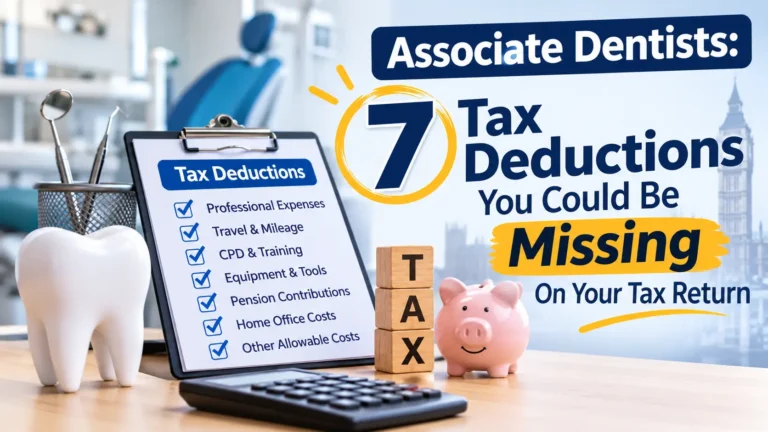 7 Tax Deductions For Associate Dentists | Dental Tax AdvisorsNovember 26, 2026 · 8 min read
 Locum Doctor Self Assessment: Why Your January Tax Bill Could Be 150% Of What You ExpectedNovember 20, 2026 · 7 min read
 How NHS Doctors Can Avoid the 60% Tax Trap | Med Tax AdvisorsNovember 17, 2026 · 7 min read
 NHS Pension Tax Planning: Avoid Costly ChargesNovember 11, 2026 · 7 min read